Accurate yaw estimation is a bottleneck in cross-view localization between ground view and Bird's Eye View (BEV). Existing methods couple yaw with translation and rely on height or projection assumptions that degrade under large yaw ambiguity. We disentangle yaw from location accuracy and introduce LAYS, a radially invariant line-consensus voting method. By exploiting the radial invariance of our formulation, we achieve sub-degree yaw precision via 3D voting over all candidate poses, while eliminating the need for accurate location.
Our key observation is that a ground-image column matched to BEV pixels induces the same yaw across all camera positions along the radial direction of the pixels. LAYS matches BEV pixels to ground columns using feature similarity and accumulates the induced yaw votes into discrete 3D bins, where correct correspondences along the radial line concentrate into a sharp peak for the correct yaw. Experiments on Mapillary, Ford, KITTI, and VIGOR show significant gains under unknown yaw (+28~45%p for normal FoV), and using LAYS as a yaw prior further improves downstream 3-DoF localization.
Ground–BEV yaw is hard when location is uncertain: pixel-to-pixel matchers entangle orientation with translation and often depend on ground height. LAYS instead treats yaw as a line alignment problem.
Ground pixels are aggregated into column features (height-free). Matching a column to BEV pixels defines a radial line whose induced absolute yaw is the same for every camera position along that ray. Match scores vote into a 3D pose tensor (yaw × 2D location); correct correspondences concentrate at the true yaw while incorrect matches disperse.
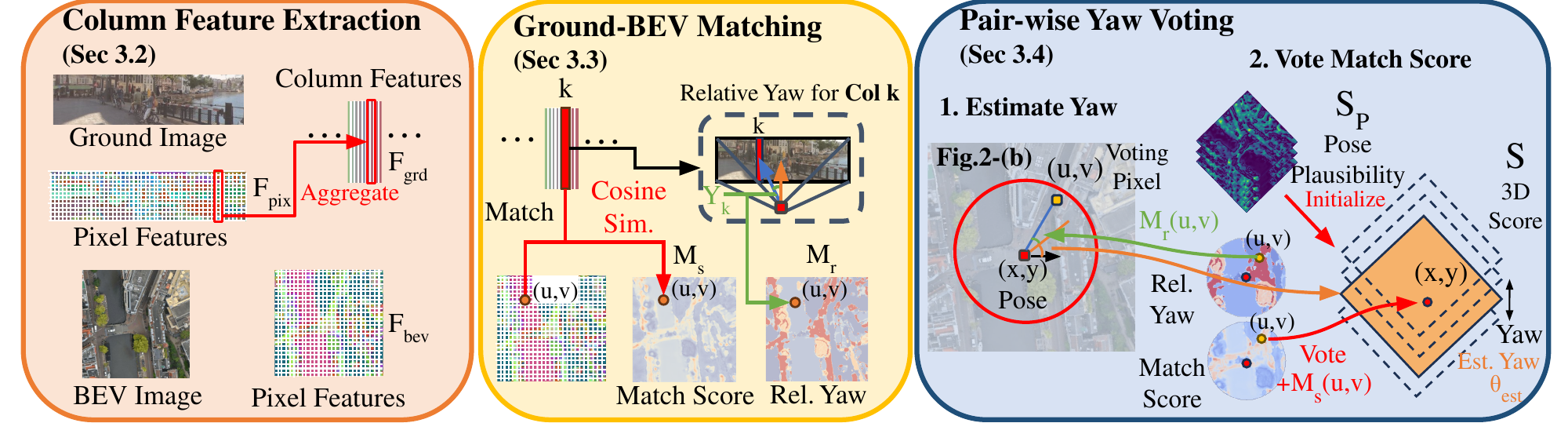
Column features → ground–BEV matching → pair-wise yaw voting.
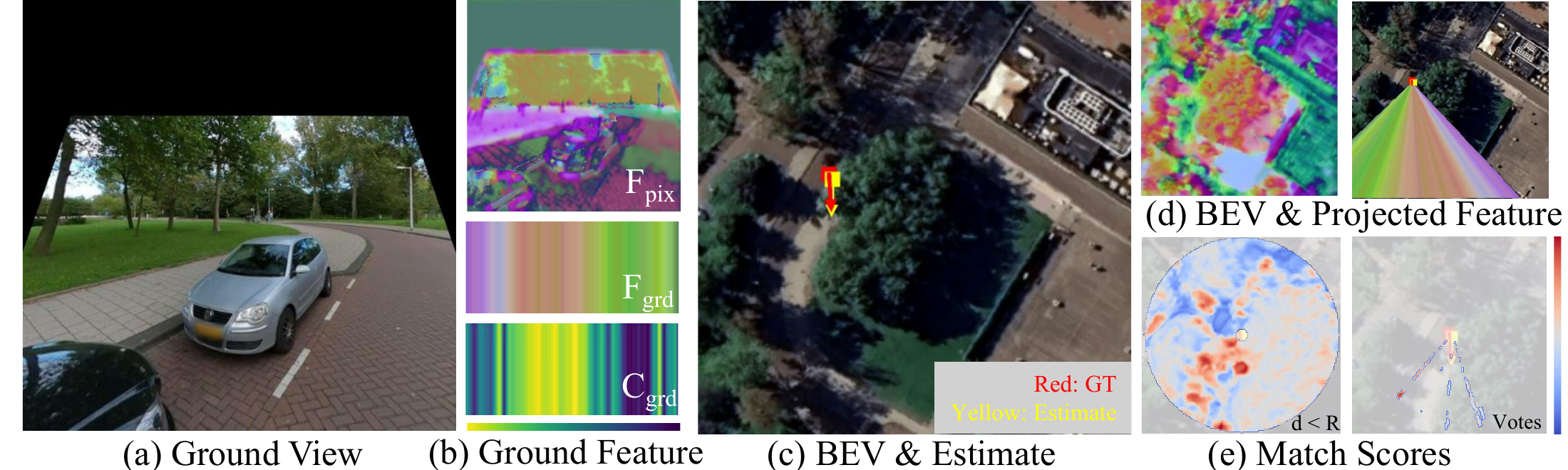
Under fully unknown yaw (±180°) and ±20 m location noise, LAYS improves angular accuracy by large margins on Mapillary, Ford, KITTI, and VIGOR (about +28–45%p within normal FoV settings in the paper). Using LAYS as a yaw prior also improves downstream 3-DoF localization.
Example on MGL: columns, BEV pose, and match-score peak at the correct yaw.
Angular accuracy (% of estimates within θ° of ground truth) under ±20m location noise on four benchmarks. LAYS achieves state-of-the-art results across all settings, with particularly large gains under fully unknown yaw (±180°).
| Method | ±45° yaw noise | ±180° yaw noise | ||||
|---|---|---|---|---|---|---|
| <1° | <2° | <4° | <1° | <2° | <4° | |
| CCVPE | 21.36 | 40.78 | 68.15 | 6.55 | 12.55 | 23.79 |
| BoostAcc | 7.40 | 14.19 | 27.54 | 0.58 | 1.09 | 2.13 |
| G2S | 32.67 | 57.49 | 82.50 | 0.59 | 1.27 | 1.86 |
| FG2 | 18.59 | 34.97 | 59.20 | 3.13 | 6.28 | 12.44 |
| LAYS (Ours) | 72.10 | 90.16 | 95.63 | 34.81 | 52.42 | 61.74 |
| Method | Same Area | Cross Area | ||||
|---|---|---|---|---|---|---|
| <1° | <2° | <4° | <1° | <2° | <4° | |
| CCVPE | 8.96 | ≤26.48 | ≤42.75 | 3.14 | ≤9.24 | ≤14.56 |
| BoostAcc | 0.53 | 0.90 | 1.96 | 0.56 | 1.05 | 2.09 |
| G2S | 0.58 | 1.17 | 2.17 | 0.54 | 0.82 | 1.64 |
| FG2 | 1.62 | 3.15 | 6.47 | 1.62 | 2.96 | 6.13 |
| LAYS (Ours) | 52.98 | 65.07 | 67.72 | 49.59 | 58.92 | 60.25 |
| Method | <1° | <2° | <4° |
|---|---|---|---|
| CCVPE | 41.36 | 62.74 | 75.11 |
| BoostAcc | 24.38 | 43.24 | 67.86 |
| G2S | 16.81 | 47.71 | 68.43 |
| FG2 | 16.75 | 41.84 | 57.13 |
| LAYS (Ours) | 67.05 | 85.14 | 91.76 |
@inproceedings{kang2026lays,
author = {Kang, Taeho and Zhang, Nairan and Kim, Yelin and Shi, Yujiao and Lee, Youngki},
title = {Cross-View Yaw Estimation in Location Uncertainty with Line-Aligning Yaw Scoring},
booktitle = {Computer Vision - {ECCV} 2026 - 19th European Conference, Malm{\"{o}}, Sweden, September 8-12, 2026, Proceedings},
year = {2026},
month = {September},
publisher = {Springer},
series = {Lecture Notes in Computer Science},
}